Saturday, 17 June 2017

Chassis work begins

Since my last post I've been working mainly on my chassis. I got it back from sand blasting and promptly gave all the 'good' parts a coat of epoxy metal paint. It claims to be able to be applied straight to clean metal. I figure sandblasted is pretty clean so I went with it and it's come up well. I used Dulux Metal Guard, Satin Black. I'll give the whole thing another coat once all welding work is finished.


The paint looks quite glossy while it's wet but it dries flat.

First repair job was the front of the chassis rail, I cut the square cap from the front of the rail, removed the dirt and debris, wire brushed the inside and splashed some rust converter around inside. Followed by welding a new square piece of steel on the front.


Bulkhead outriggers were next, passenger side was repairable so I chopped out the swiss cheese sections and the angle brace. Cut new steel, welded in, then linished back to smooth. I used a piece of 30x30 angle iron to replace the brace. The original was a piece of folded steel, so I smoothed the sharp angle off the new piece for the original look.


Drivers side outrigger was beyond help, so I took some reference measurements and cut it off. You can buy replacements but as it's a pretty basic piece of fabrication I made my own. I cut the square blocks off the original and welded them to the new one, so it looks authentic.


I have only tacked it to the chassis, I'll fully weld it once the bulkhead has been fitted, just incase there are alignment issues. Although given the variations from side to side on the chassis, I guess you could drive a truck through Land Rover's tolerances, so it should be fine.

Next was the rear cross member, the most common area of a Land Rover chassis for rust to inhabit. I considered patching it, but it looks way too rusty on the inside, and it's made of all sorts of intricate folds so would be hard to replicate the parts. So I wanted to remove the cross member without disturbing the chassis rail ends (which also need repairing) so that I can measure their original length to re-create them. Before cutting, I made a jig so that a new cross member can be fitted in the exact same place.


Took a lot of perseverance with the angle grinder, but I got it off without cutting through the chassis rails, well what was left of them. I then made a cardboard template to give the shape and length of the ends of the rails. Then they were cut back flush with the spring hangers. The reason I'm doing this, is so that I can use a new crossmember without the extension rails, as the type with extension rails make the repair really obvious as it slips over the existing chassis. This way my repair can be more or less hidden.

Chassis work is on hold now until I can get my hands on a new crossmember. Still unsure whether I will buy one locally or from the UK. Still need to figure out what is cheaper.

While all this chassis work has been going on, my order from LRdirect.com arrived with all the parts to start assembling the rear axle.


'Distance Pieces' shrunk onto the stub axles using an induction heater.


Diff centre fitted with new gasket. Pinion seal and mud slinger also replaced. I need to wait until the axle is back under the chassis with some weight on the wheels, so I can torque up the pinion nut.

Then assembled and fitted the hubs and brake backing plates. I haven't set the hub end float, as they may need to come back off to fit the brakes, but it's good to have it all together loosely, just so the parts are all accounted for.


Wednesday, 7 June 2017

Leaf spring refurbishment

Spent Queens Birthday long weekend working on making the leaf springs presentable. They were in pretty bad shape, a lot of rust and pitting but they still have a reasonable curve in them so I'll take a punt on re using them. If I had the money I would buy new springs but if I was replacing everything this project wouldn't be happening.

So first I stripped the spring packs apart. The leaves were so rusted together that I had to use a hammer & chisel to separate them. Next was the challenge of removing the spring bushes. I made a puller with some M12 threaded rod, some tube and a boss I turned down to a diameter slightly less than the bush.

  
Once apart, I buzzed off as much of the rust as I could with a wire brush on the grinder.


I then applied CRC rust converter to help with the remaining surface rust.


A smear of assembly paste between the leaves


And reassembled and painted.


Another spring related job that needed doing was the spring plate/shock absorber mounts. The original pins were really worn and beyond repair, due to the shock absorber bushes collapsing. I dissected them and cut the pins from the plates. Cut some new shafts from 3/4" stock and welded them back onto the plates. Should be good for another 40 years


I'm expecting a package from www.lrdirect.com any day now, which has all the seals and gaskets etc for me to reassemble to rear axle, so expect a post about that soon.

In other news, I've put the engine on an engine stand so that I can move it around.


And the chassis is off to the sandblaster tomorrow


Stay tuned..

Tuesday, 30 May 2017

Clean, Paint, Repeat

This week has consisted mostly of cleaning 40 years of built up grease and mud from the rear axle components. It's slow, tedious and makes an absolute mess of my garage , but I've now got all components of both axles cleaned and painted, except the diffs.


I picked up a replacement diff to replace the knackered rear diff. It's a late series 3 diff, and seems to be in good condition with minimal play. These diffs have a flat bottom, and don't have the bolt on pinion oil seal carrier like the earlier diffs. They came about in 1971 when the Range Rover was released, as the same casting is shared across all models. So late Series 2A's, and all 3's (SWB) should have this type of diff. I'm now chasing a second diff like this, so that I have a matching pair front and back. I've cleaned up my front diff and it appears to be a very early series 1 diff, stamped 1953! So I definitely want something more 'era correct'


Newly acquired series 3 diff on the left. Old front diff on the right, possibly a Series 1 type. 

While having a look at the gearbox, I went in search of the serial number. Turns out its a Series 2A gearbox. Seems this Land Rover has had a fair bit of parts swapped over it's life. So now I'm on the lookout for a series 3 gearbox, to keep it all correct. The 2A box would be fine, but they don't have a synchromesh on 1st and 2nd gear, so there is a noticeable difference.
Gearbox serial number

I hope to have the chassis sandblasted next week, then it's going to be a nice change from cleaning and painting, to grinding and welding.

Stay tuned.

Tuesday, 23 May 2017

I've been busy!

I've been neglecting the blog in the last week, I've made a lot of progress but haven't done any updates. Rather than spill too many words Ill let the pictures do the talking.

Basically I've :


  • Stripped the rear diff. Found that the front pinion bearing had suffered a catastrophic failure, hence the seized diff. The rollers had friction welded to the raceway. This caused the bearing to spin on the shaft until it also friction welded to the spacer next to the bearing. basically it's f**ked and I will source a replacement diff head. I hope to find the 'proper' Series 3 type with the flat bottom casting and press in oil seal on the pinion shaft. This diff is the older style with the aluminium bolt on seal retainer.


  • Welded the donor panels into my good bulkhead, and scrapped the rusty old one. (no pics of this sorry)
  • Stripped the front axle, boxed up the disc brake setup as it's going back to Brian, who I bought the Land Rover from, I'm swapping him the disc brakes for some parts I need. I cleaned up the remaining parts with the wire brush wheel, applied CRC rust convertor, then painted in semi gloss black. I have borrowed this technique from Geoff @ http://www.geoffslandroverblog.com/ It's cheap and seems to work well. 


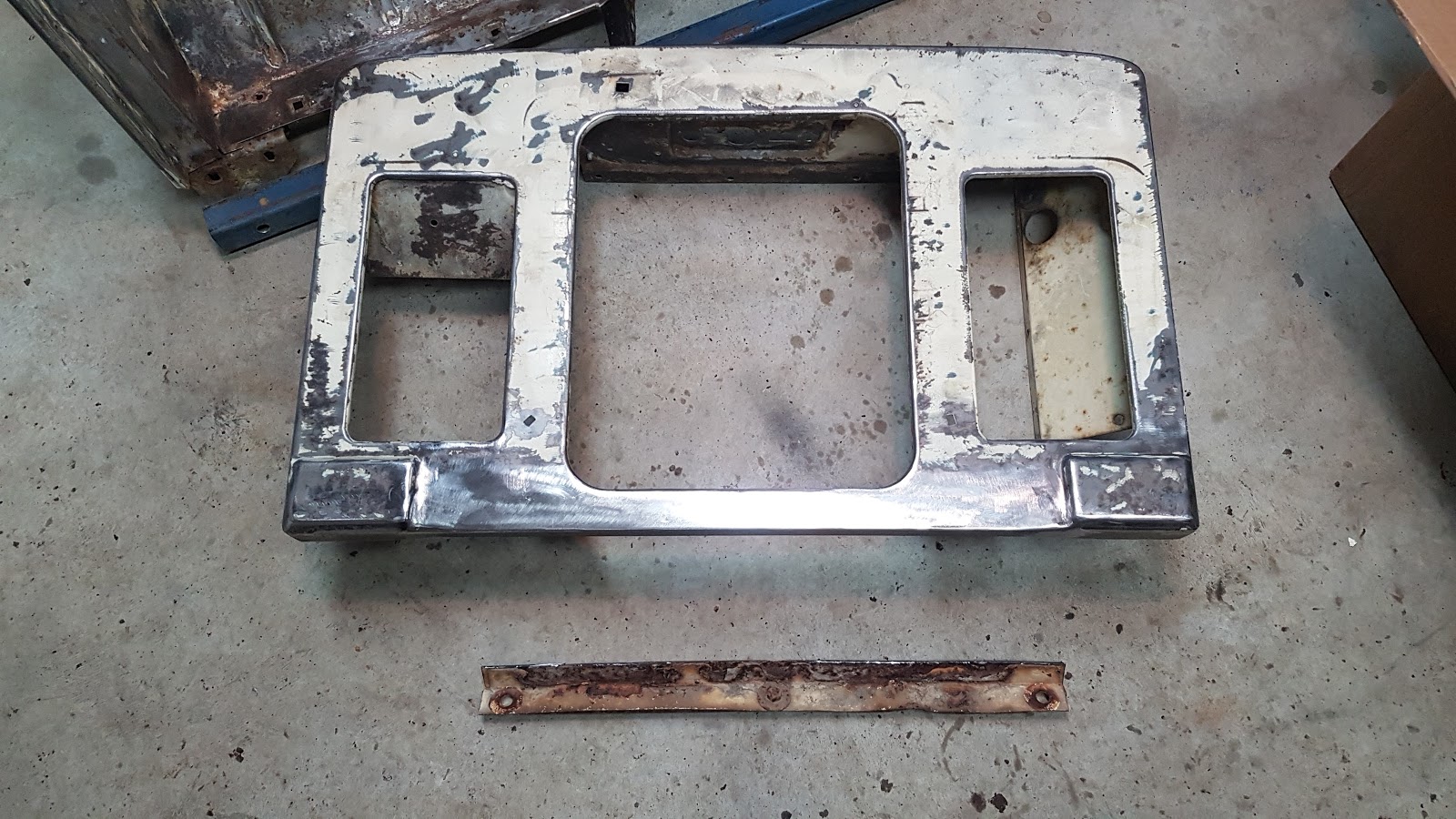
  • I repaired the rusty front radiator panel, it had the common rust/swelling in the lower piece of channel. I cut it out and welded in a piece of 30mm angle. 


I'm really just trying to do as much 'free' stuff as possible while I'm saving to have the chassis sandblasted. I hope to get that done in the next few weeks.


Sunday, 14 May 2017

Chassis Stripped Bare, Rear Axle Dismantled, Bulkhead Continues...

Last few days have been spent on a mixture of things. Firstly I removed the rear axle, Leaving the chassis bare. I was able to get 5 of the 6 shackle pins out, with the angle grinder being needed to get the last.

Both axles removed from chassis
Once that was out of the way I went back to do some work on the bulkhead. I wanted to get this done so I could throw out the rusty bulkhead and get some space back in the garage. I drilled out all the spot welds holding the centre panel and sides of footwells. This way I was able to cleanly remove it all as one piece.

Stiffener plate removed
Centre panel removed

It fits perfectly into the 'new' bulkhead, I've left it sitting there loose as I need to wire brush and prime the surfaces that will be overlapped. I hope to get it welded in next week, I will take it to work so I can use the MIG welder. 


Next job was to remove the spring bushes from the chassis, which isn't as straight forward as you'd expect it to be. They rust/seize into the bore, meaning you can't drift or press them out (though I did try) I ended up first removing the inner tube and rubber; some I was able to smash out, the others were set on fire, to burn the rubber. I then used a hacksaw to split the outer tube of the bush, releasing their grip. Then used a BFH to drift them out. I didn't taken any photos of this process, slack. 

I then took the chassis outside and gave it a good water blast/degrease. I want to get it as clean as possible before it is sent off for sand blasting. I rigged up a sack barrow with a ratchet strap to move the chassis, allowing me to lift one end of the chassis and walk it like a giant wheelbarrow. Once outside I hit it with the water blaster, doing both sides. It has come up pretty good, it's amazing how much of the original paint was still intact under the layers of dirt/grease.


With the chassis clean and back in the shed I started to strip the rear axle. When I bought the Land Rover I was told the rear diff was seized (half shafts & drive flanges had been removed to allow it to roll) so I was interested to get in and have a look at the diff. Everything was coated in oil so it all came apart easily. I was expecting to find the axle casing full of metal particles or bits of gear teeth (hence the seized diff) but it all seemed very clean. With the diff on the bench it seems OK visually, all teeth are OK, no major wear to the teeth. There is slight play in the ring gear so I assume that isn't seized, the spider gears spin freely but the pinion shaft is locked solid. I will strip the diff down this week and find out what is going on with it, hopefully it's a straight forward fix. 


Long overdue update

It's been over a year since I posted here so I thought i should bring the blog up to date, incase anyone out there actually reads it! ...